GTM is a standard marketing concept.
This white paper introduces MTY or “Market To You”.
The other side of the GTM coin.
The scope of this white paper relates to sellers of complex technology related services and product offerings, including but not limited to IT Services, cyber security, application development, AI, hosting, comms, MarTech, ProcureTech, digital transformation, network, IT infrastructure, and Governance, Risk and Compliance services.
Abstract
A technology services sale is a challenging sale to close. There is the issue both of a buyer who may not be a specialist in the area concerned, and a product or service that is indeed complex and difficult to clearly explain.
To overcome this there is a core element of GTM strategy where the technology company will invest in making the product appear strong from a branding and perception perspective, so that it can become the “trusted” vendor of choice, which can sidestep the challenge of the buyer really understanding why this should be, or indeed how the company is better than the competition.
A secondary strategy is to employ partners, who have access to the target market, and provide them with commissions and incentives that are larger than what the competition offers, effectively purchasing market access. The risk here is that it is the size of the incentive of the partner that drives the power of the argument and can distract the tech buyer from a better vendor option.
The first is more the evangelical approach, the other is the strategy of buying into a marketplace.
While both strategies are proven to work, neither is satisfactory for the technology services buyer who wants to more fully understand the marketplace, the detail behind the technical offerings, and what the differentiators are between the different providers. This is the buyer who wants to be able to look past the branding, and make sure that the decision is made on technical merits; capabilities that need to be clearly identified.
The evangelical strategy also has its risks from a vendor perspective, because the detail of the sales conversation needs to be deeper and longer, giving more opportunity for the buyer to lose interest. Nobody likes to be “talked at”, and ironically, the more detail behind a sales process, and the more the outbound selling communication, the greater the risk that the chance of a sales opportunity can be diminished.
Beyond GTM strategy, this white paper argues that there is benefit for a further additional market strategy: the “Market To You” or MTY strategy, where the decision making process is more technology buyer led rather than vendor led.
GTM / “Go To Market” Strategy
GTM is at the heart of marketing; marketing professionals will be familiar with the key elements of the strategy.1
GTM enables three key objectives
I. Marketing team generating leads (incoming enquiries or pre-prepared lists)
II. Sales team contacting leads2
III. Sales team converting leads into paying customers
STEP I : Generate leads
Analyse your market by identifying…
a) the companies who need your services.
b) when they need your services.
c) the profile of individuals who buy your services.
d) the right way to reach out to those individuals (email, telephone, digital advertising, conferences, corporate events, conferences, white papers, direct advertising, indirect advertising, SEO, PR, referral partners…).
Communicate to those individuals in the right way, at the right time, so that they can notify you of their interest, thereby becoming “leads”.
STEP II : Contact leads
a) Define a sales script, communications strategy, and communication methods that will confirm and grow interest in your offering.
b) Reach out to the leads – confirm the interest, schedule follow up meetings.
STEP III : Convert leads into paying customers
a) Confirm the generic elements of your service offering, and identify how your offerings are better than or differentiated from the competition’s.
b) Negotiate prices, and sign contract.
MTY / “Market To You” Strategy
An MTY strategy is the strategy of letting the buyer do the vendor research easily, compare companies effectively, and become informed themselves: enabling the sales cycle to be shorter, and the buying decision to be more easily made.
The result of an MTY strategy is that buyers come direct to the vendor being both informed, aware, and closer to making that buying decision.
What are the disadvantages of an MTY strategy?
Companies who cannot articulate how they are better than the competition (value, functionality, strength of delivery, technical capability, product specification, competitive advantage delivered) will not be able to benefit from hifo as much as the stronger company that knows the better value it offers. The typical approach of the weaker company is purely the GTM outreach, and hopefully closing the contract before the buyer gets to understand the better competition out there. Hifo makes that better competition clear.
GTM strategy is about getting that lead, and sealing the deal, before the competition hear about it.
MTY strategy is about wanting to be compared with the competition, being comfortable with the buyer knowing the entire market, and having confidence in the strength of product and service.
The six key steps of any MTY strategy are
I. Let the buyer easily find you.
II. Let the buyer easily understand what your generic core offerings and key differentiators are.
III. Provide quantitative information that further establishes the credibility of your company.
IV. Enable the buyer to easily compare you with the competition.
V. Enable the buyer to make that initial shortlisting assessment.
VI. Allow the buyer to easily get in touch with you.
The contacted vendor will know that the buyer…
(a) Understands what they do.
(b) Knows the competition.
(c) Has chosen to reach out to the vendor, rather than the other way round.
(d) Is significantly closer to a sale than a GTM lead.
With MTY there is no need for the standard sales spiel, or the generic, challenging discovery conversation (How much does this person know versus what I need to tell them? How much knowledge and general understanding do they have? What language / complexity of terms can I use?).
The conversation can instead immediately move onto understanding the use case, going into details of a potential solution, and starting to draft up a scope of services.
“GTM” The vendor goes out to the market to find buyers. The vendor has agency.
GTM services are focussed on generating leads and sales for vendors. The vendor initiates the process, and buyer is led down the path to become a lead. GTM involves persuasion with advertising, and gamification with SEO. GTM includes brand building, and all typical launch activities.
“MTY” The buyer goes out to the market to find the right vendor. The buyer has agency. The buyer initiates if they will make an enquiry or not and become a lead.
MTY services are focussed on qualitative and quantitative information that helps the buyer understand a marketplace, the vendors in that marketplace, and more easily assess and discover the right vendor for their needs. MTY is concise and fact focussed – eliminating the need for sales spiel. MTY is also critical to effective brand building.
MTY requires strong definition of the USP and product brand messaging (both outputs of GTM).
MTY supplements GTM objectives of Market Penetration, Revenue Growth, Customer Acquisition, Brand Awareness, Competitive Advantage and Sustainable Growth.
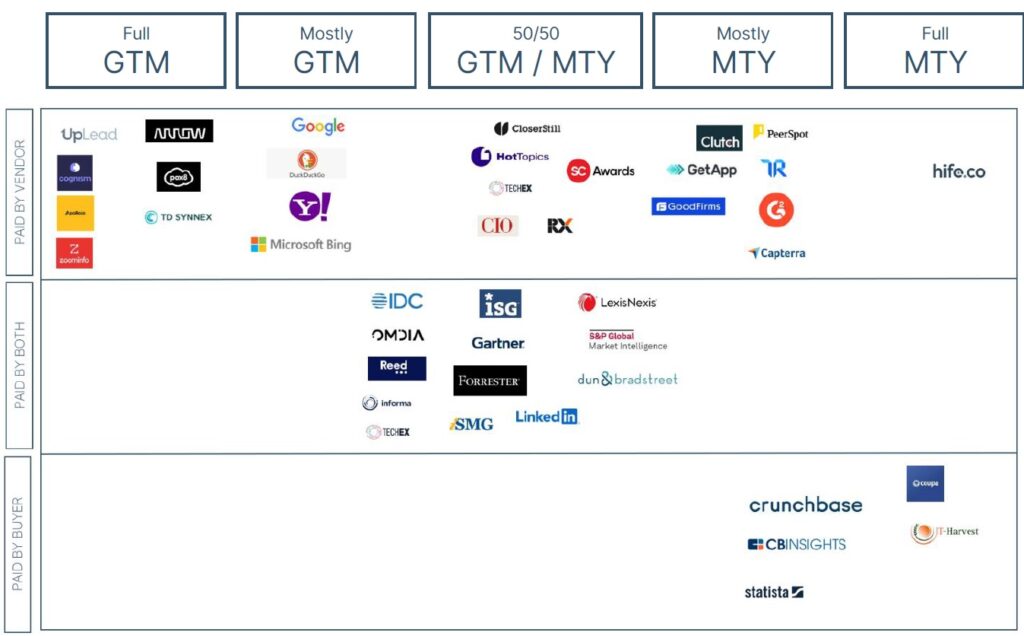
GTM vs. MTY service vendors
About hifo
Hifo is a B2B directory and flexible taxonomy of services designed for MTY.
Hifo is self-service enabling vendors to create or claim and then update their profiles.
Helping the buyer decide
There are four essential steps that a tech buyer should follow to identify the best technology supplier for their needs.
1. Understand what the service or product that they are looking for is.
2. Understand who the relevant vendors are of that service or product.
3. Compare the vendors.
4. Identify the vendors that will likely be a best fit for their needs.
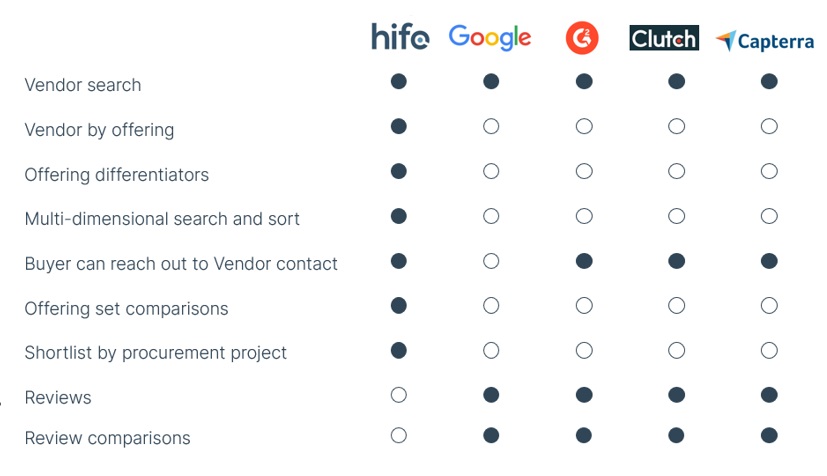
Hifo helps the buyer with all four steps.
- Understand what the service or product is
Hifo is a dictionary of services, clearly defined, so that the buyer becomes easily informed what the service or product is about. - Discover the relevant vendors
Hifo provides succinct clear profiles, with generic offerings, and offering differentiators, enabling a buyer to discover the relevant vendors. Hifo offers “pre-matching” of potential fit vendors by search criteria including
- turnover
- profitability
- preferred client size
- countries served.
A shortlisting functionality is available to any registered user of the platform.
- Compare
Hifo provides succinct clear profiles, with generic offerings, and offering differentiators, enabling a buyer to compare one vendor with another from a functional perspective. Hifo is the only platform that caters for a “knowledge split” between the generic, and the differentiator or value add, making it easy for companies to articulate their differences clearly, and facilitating the buyer’s decision-making journey.
https://www.hifo.co/companies/hifo
© Hifo Ltd. 2025.